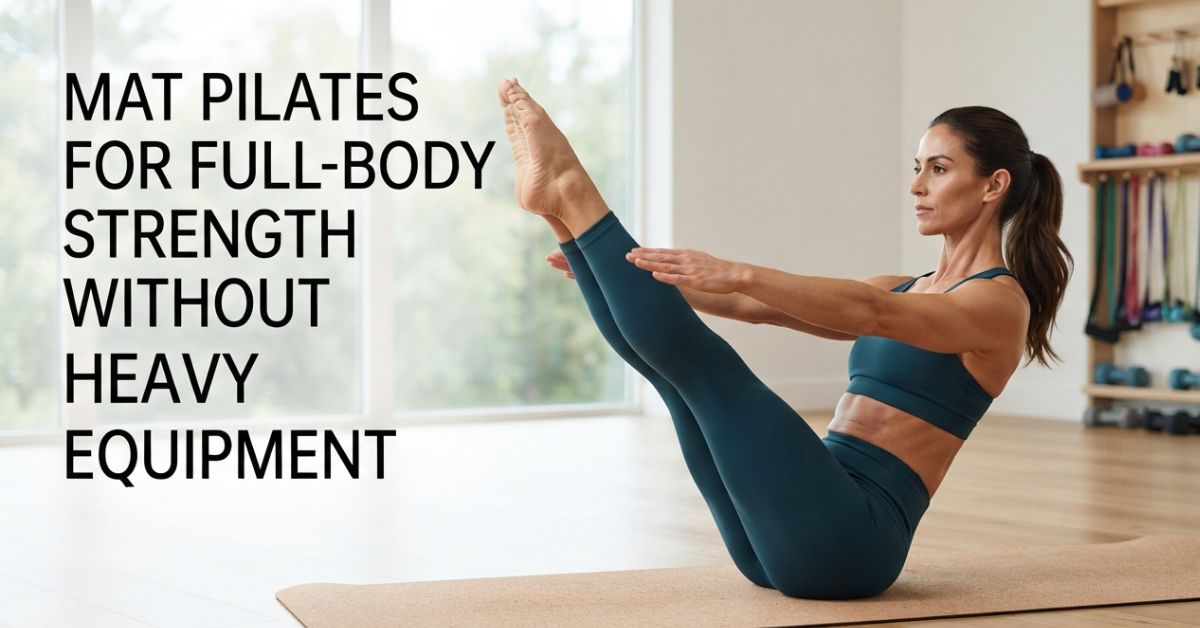
Strength training often brings dumbbells, barbells, and gym machines to mind, but they are not the only ways to challenge your muscles. Your own body can provide resistance when exercises are performed with the right positioning, control, and pace. That is one of the main ideas behind Mat Pilates.
A typical Mat Pilates Workout uses deliberate movements that ask several muscle groups to work together. Instead of trying to lift the heaviest weight possible, you concentrate on keeping your body stable while moving with control. This approach can work the core, legs, glutes, back, shoulders, and arms without making heavy equipment the focus of the workout.
How Mat Pilates Builds Full-Body Strength?
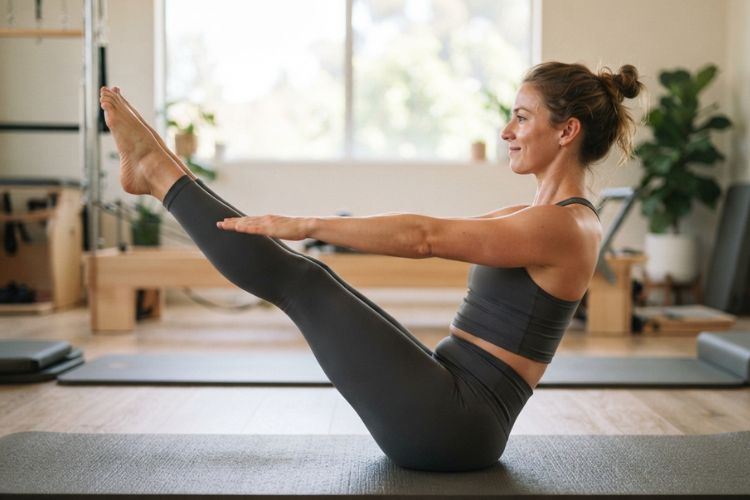
Mat Pilates creates resistance in a different way from traditional weight training. Body weight, gravity, balance, and muscle control all contribute to the difficulty of an exercise. Even a familiar movement can become more demanding when you slow it down and remove momentum.
A leg lift is a simple example. Swinging the leg up and down may not feel particularly difficult, but lifting it slowly while keeping your hips and torso completely still changes the exercise. The muscles have to control both the upward and downward phases rather than relying on speed.
This is an important part of Pilates Strength Training. The goal is not simply to complete more repetitions. It is to maintain good positioning while the muscles continue working.
- Strength Starts With Stability
Many Pilates movements ask one part of your body to remain steady while another part moves. During a toe tap, for example, the legs move while the abdominal muscles help control the pelvis and trunk.
The same principle appears in planks, bird dogs, bridges, and side-lying movements. You are not only moving through an exercise; you are also resisting unwanted movement elsewhere in the body. That combination can make relatively simple exercises much more challenging.
Which Muscles Does Mat Pilates Work?
Pilates is strongly associated with core training, but a well-designed session goes far beyond the abdominal muscles. Different positions shift the workload throughout the body, which is why Full Body Pilates can cover several major muscle groups in one workout.
1. Core and Back
The core helps create a stable base for movement. Exercises such as toe taps, dead-bug variations, planks, and controlled leg extensions require the abdominal muscles to stay active while the arms or legs move.
Back muscles also contribute to posture and stability. Certain Pilates Exercises encourage you to control the spine rather than simply bending or twisting through a movement.
2. Glutes and Legs
Bridges, leg circles, side leg lifts, and single-leg variations bring more attention to the lower body. The glutes and hamstrings work during hip extension, while side-lying exercises can challenge the muscles around the hips and thighs.
The movements do not have to be large to be effective. Keeping the hips steady during a small leg circle, for instance, can make the exercise considerably harder than performing a larger uncontrolled movement.
3. Shoulders and Arms
Upper-body work can come from supporting your own weight. Planks, side planks, and certain quadruped exercises place resistance through the arms and shoulders while the rest of the body works to stay aligned.
This makes Bodyweight Pilates useful when you want a session that involves more than floor-based abdominal work.
Pilates Exercises for a Full-Body Workout
You do not need a long list of complicated movements to build a balanced routine. A handful of exercises can target different areas when they are performed carefully.
Here are several movements commonly used in a full-body mat session:
- Glute bridges: Work the glutes and hamstrings while asking the core to stabilize the pelvis.
- Toe taps: Challenge abdominal control as the legs move away from the body.
- Bird dogs: Train balance and trunk stability while working the back and glutes.
- Side leg lifts: Target the hips and outer thighs while requiring the torso to remain still.
- Planks: Engage the core, shoulders, arms, and legs at the same time.
- Side planks: Add more work for the side of the trunk and supporting shoulder.
The number of repetitions matters less than how well you perform them. If your form starts changing halfway through a set, reducing the repetitions can be more useful than pushing through with poor control.
What Beginners Should Focus on First
Beginners do not need to rush into advanced movements. Start with breathing, pelvic control, bridges, toe taps, and modified planks to become comfortable with the basics.
During a Beginner Pilates Workout, focus on steady movement and proper form rather than a large range of motion. If you lose control, make the movement smaller or choose an easier variation.
Why Slow Movements Feel Harder Than They Look
One reason Pilates can surprise beginners is that the exercises often look easier from the outside. There may be no heavy weights, explosive jumps, or fast repetitions, yet the muscles can start working hard within a short time.
Tempo plays a large role here. Moving slowly keeps the muscles involved for longer and gives you less opportunity to use momentum. You also have more time to notice whether your hips are shifting, your shoulders are lifting, or another part of the body is compensating.
That controlled pace is one reason Mat Pilates can create a challenging workout without heavy equipment. A smaller movement performed with control may demand more muscular effort than a larger movement performed quickly.
How to Progress Without Adding Heavy Weights?
Your body adapts when you repeat the same exercises regularly. Once a routine starts feeling easier, you can increase the challenge without immediately adding weights. Pilates Strength Training gives you several simple ways to progress.
1. Slow Down the Movement
Take more time with each repetition or pause briefly at the hardest point. This keeps the muscles working longer and makes it harder to rely on momentum.
2. Try a More Challenging Variation
Progress from easier movements to more demanding versions. A regular bridge can become a bridge march or single-leg bridge, while a knee plank can gradually progress to a full plank.
3. Increase Repetitions or Range
Add a few controlled repetitions or gradually increase your range of motion. With Bodyweight Pilates, small changes like these can keep familiar exercises challenging as your strength improves.
Building a Balanced Mat Pilates Workout
A balanced session should move naturally from one exercise to the next. Start with gentle movement and core activation, move into lower- and upper-body work, and finish with mobility.
A simple routine may include:
- Gentle spinal movement
- Toe taps
- Glute bridges
- Side leg lifts
- Bird dogs
- Plank variation
- Light stretching
This Full Body Pilates sequence can be adjusted to your fitness level. Beginners can use modified positions, while more experienced participants can add longer holds or challenging variations.
How Often Can You Practice Mat Pilates?
How often you practice depends on your fitness level, routine, and recovery. If you are new to Mat Pilates, two or three sessions a week can be a comfortable starting point while you learn the movements and build strength.
You also do not need an hour-long session every time. A focused 20- to 30-minute workout can be enough when each movement is performed slowly and with proper control.
Pilates can easily fit around walking, running, cycling, strength training, or other activities you already enjoy. The aim is to find a routine that gives your body enough movement without making your weekly schedule difficult to maintain. If you prefer guided practice, mat Pilates Columbus classes can help you learn correct positioning, useful modifications, and ways to progress at a comfortable pace.
Strength Does Not Always Need Heavy Equipment
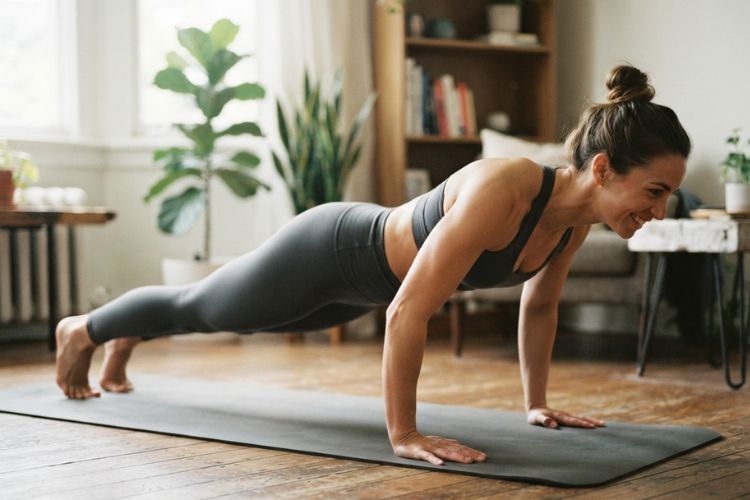
Building strength is not only about how much weight you can lift. How well you control your body matters too, especially when an exercise requires several muscles to work together.
A consistent Mat Pilates Workout can challenge the entire body using resistance that is already available: your own weight. As exercises become easier, changing the tempo, position, range, or level of support can keep the workout demanding.
At Pilates Plus Columbus, mat-based Pilates gives people a practical way to work on full-body strength without depending on heavy gym equipment. Start with movements you can perform well, give yourself time to improve, and let better control guide the next stage of your practice.
FAQs
Is Mat Pilates good for building strength?
Yes. Mat Pilates uses body weight and controlled movements to work the core, legs, glutes, back, and upper body.
Can beginners do Mat Pilates?
Yes. Beginners can start with simple exercises and modified positions before moving to more challenging variations.
Can you do Mat Pilates without equipment?
Yes. Most exercises only require a mat and enough space to move comfortably.
How often should you do Mat Pilates?
Two or three sessions per week can be a practical starting point for beginners. Frequency can increase depending on fitness level and recovery.
How long should a Mat Pilates workout be?
A workout can last around 20 to 60 minutes. Even a shorter session can be effective when movements are performed with good control.